
A Month for Observance, Education and Evaluating Opportunity – The Increasing Impact of End Stage Renal Disease on Employers
March 12, 2026
During March, we recognize both National Kidney Month and World Kidney Day. It’s the time of year when a lot of great organizations help shine a light on prevention and treatment of kidney disease while educating the community on how critical this health issue really is for our country. This time of year is also a timely opportunity for employers to get a better grip on the impact kidney disease is having on the bottom line and across their workforces.
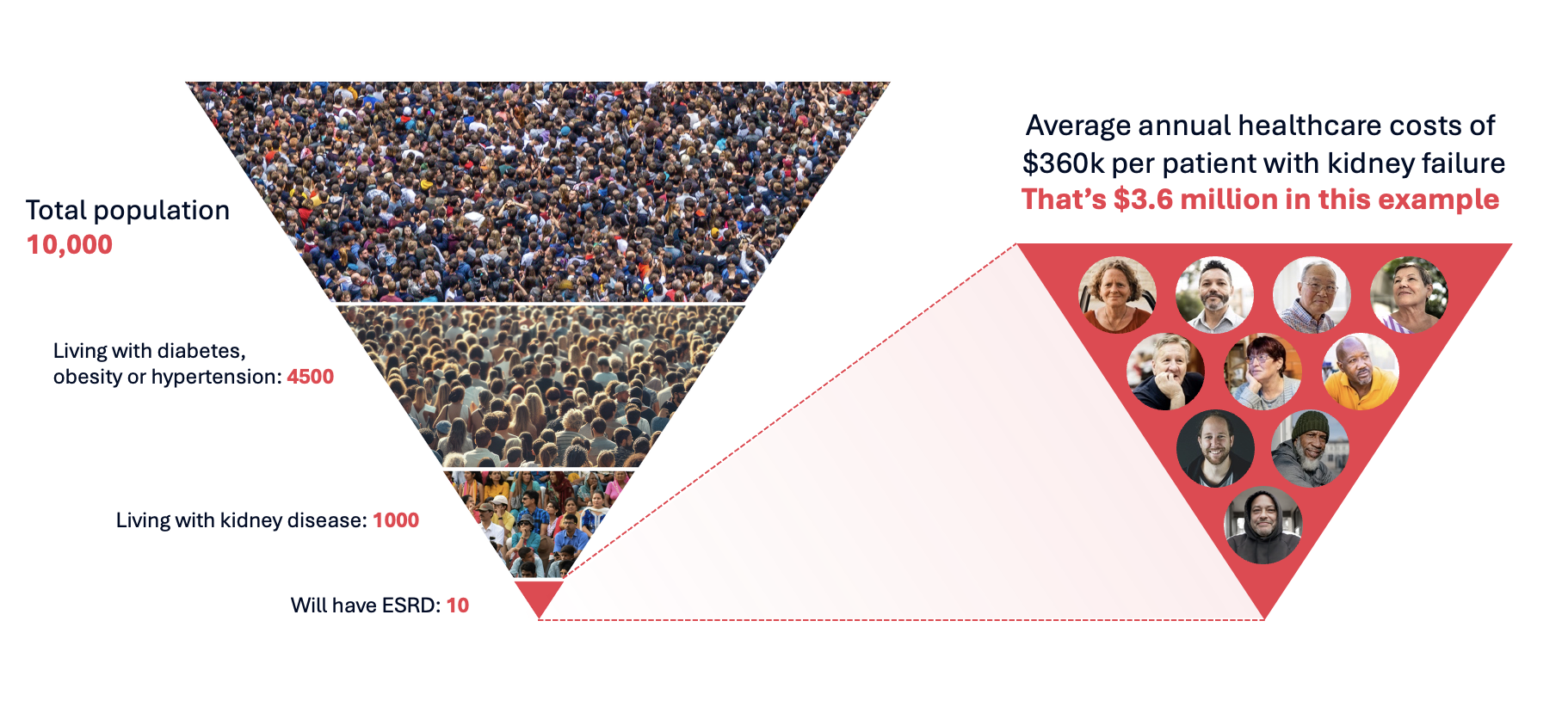
End Stage Renal Disease (ESRD) typically flies under the radar in most organizations because of the nature of how claims flow and its low overall prevalence. While ESRD affects a very small portion of a given population, it wields significant consequences, both in terms of its financial and human toll. For employers, every individual with ESRD is generating roughly $35k per month in healthcare expenses. Meanwhile, for those battling kidney failure, health and productivity are constantly being drained by debilitating dialysis treatments.
The image below demonstrates how this adds up for employers, as well as illustrating the consistent, and in many cases inevitable, progression from chronic conditions such as obesity or diabetes, to chronic kidney disease, to kidney failure. As you can see, in a sample population of 10k, only a small percentage of individuals will ultimately advance to ESRD. However, the financial burden for employers is consequential.
As we consider the recent trajectory for ESRD in this country, it appears this is only getting worse for employers. Here are three reasons why:
The Cost of Treatment Continues to Climb
From 2012 to 2019 the average cost of a single dialysis treatment ballooned 23%, from $1,200 to $1,476. Based on our most recent analysis of client data, this cost is trending closer to $1,750 per treatment. With every passing year, this condition will increase its negative impact on benefit budgets, simply by virtue of cost inflation.
Declining Health Status Is Fueling Future Cases
Approximately 70–80% of chronic kidney disease cases (CKD) are linked to chronic conditions such as diabetes, hypertension and obesity. With every passing year, more and more Americans are managing at least one of these conditions. Studies predict that roughly half of the U.S. population will be obese within the next five years. Meanwhile, diabetes rates are set to jump by 15% in the same timeframe.
These statistics factor heavily into projections that rates of chronic kidney disease will ramp up 20% by 2030, while becoming the 5th leading cause of death worldwide by the year 2040.
Current Transplant Rates Can’t Keep Up with Relentless Demand
A transplantation is widely recognized as the gold standard of care for kidney failure. It significantly extends a patient’s life, while cutting ESRD costs by 90% post operation. Currently, only about 27K transplants are completed in the U.S. each year. Meanwhile, nearly 45K new patients are added to kidney transplant waiting lists.
With continuously rising costs, non-stop production of new cases and a system that can’t keep up with delivering care, employers must ensure they have a sound strategy for addressing ESRD within their populations.
A Strategic Response Begins by Clearly Understanding Your ESRD Burden
If you are an advisor or employer who wants to evaluate the impact of ESRD on your budget, while also examining the cost saving opportunities available by dramatically reducing wait times for transplants, please contact the Rejuvenate team today. We offer a free data analysis to improve visibility for this high-cost condition. We also can walk you step by step to help you run a self-analysis as well.