
What’s Wrong with Kidney Transplantation in the U.S.? Here Are Four Core Challenges
January 9, 2026
For individuals experiencing kidney failure in the U.S., the average wait time on a transplant list is three to five years. In total, only one out of ten people who need a new kidney will get transplanted within three years of starting dialysis treatments. Approximately 70 percent of people with kidney failure will die while waiting on a new organ. Obviously, we have to do better, but why is it so hard to help those who need a new kidney? As you might imagine, it’s not just one root cause. Here are four core challenges that prevent us from more effectively supporting individuals with end stage renal disease.
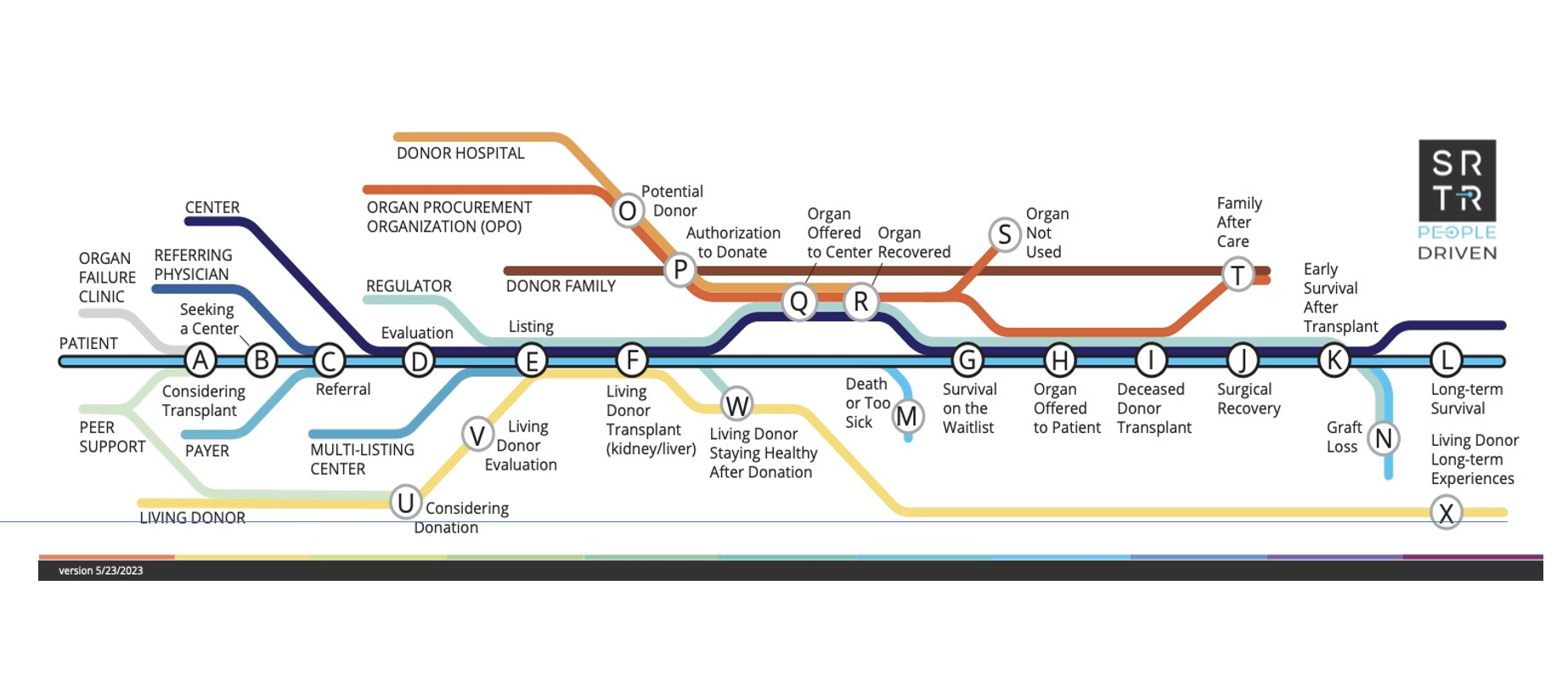
The Healthcare System Is a Complicated Maze
The image above is a transplant system map created by the Scientific Registry of Transplant Recipients. We love sharing this visual because it so perfectly illustrates just how complicated and confusing it is for individuals to successfully navigate the health care system in search of a new kidney. There are many stops along the journey, and many opportunities for patients to hit roadblocks, take an unnecessary diversion, get stalled or get completely stuck. As an example, many people unfamiliar with this process mistakenly think there is one global wait list for those who need a new kidney. In reality, every single transplant center across the country has its own wait list, and wait time can vary significantly by center or by region.
Since healthcare is practiced locally, individuals typically get referred to the closest transplant center, regardless of its average wait times. Most individuals don’t realize that they could be referred to a different transplant center with a shorter wait time. So, they sit and wait.
Health literacy and socioeconomic status can also come into play. Even well-resourced and highly knowledgeable individuals find the process challenging. For those with lower health literacy, and those who have unmet Social Determinants of Health (SDoH) needs, it can be even more daunting.
Demand Is Greater Than Supply
Demand for a new kidney far outpaces the available supply of organs available from deceased donors. Efforts to increase the prevalence of living donors, as well as the concept of paired match donations are gaining traction to bolster the number of available organs. Research in the area of xenotransplantation, using kidney from animals, is also advancing quickly. But in the short term a severe supply and demand issue prevents many individuals from getting the organ they need in a timely manner.
At the same time, roughly 20-30% of deceased donor kidney go unused. Long transport times, logistical delays in organ recovery and several other issues factor in here. Not to mention the challenge of compatibility, which adds a significant layer of complexity. The bottom line is that the system overall is fairly inefficient when it comes to matching organs with those who need them.
Meeting Eligibility Requirements Is Challenging
It’s really difficult to medically qualify for a kidney transplant. A laundry list of health issues impact eligibility, including cardiac disease, diabetes and peripheral vascular disease to name a few. Additionally, recipients can be deemed ineligible if they use and abuse various substances, including tobacco and alcohol. Physical fitness, including hitting certain BMI targets, is part of the picture, as is overall psychological health, such a depression. Even factors such as the patient’s age and their ability to pay for medications long term factor into how they fare with a selection committee.
In many cases, patients can be disqualified for an organ for relatively small infractions, such as failing a grip strength test or the presence of a cavity in a tooth. In the end, there is a gauntlet of issues that can significantly delay, or completely prevent, a person from getting a transplant.
The process for qualifying medically unfortunately encourages delays. For example, because of the status quo of long waits for a successful match, there is often not enough urgency from the health care system to complete needed referrals and evaluations for individuals. As a result, it often takes months instead of days to complete necessary tests. To make matters worse, if there is an issue identified during any of the evaluations, the onus is on the patient to get it corrected and to get the process moving again.
Incentives Are Misaligned
Like many areas of healthcare, the financial incentives in the provision of care for patients with end stage renal disease are not aligned. Here’s an example. Transplant centers are held to an incredibly high success rate. They basically have to be perfect. This means that some centers are much less likely to take a chance on a great but not outstanding kidney, or on a patient who brings some risk to the table. On the surface, holding centers accountable to a high rate of quality is a good thing. Unfortunately, the current design creates a disincentive for centers to take reasonable chances. Plus, some transplant centers only have the expertise to transplant outstanding kidneys but don’t know how to transplant great kidneys and don’t want to take this added risk. Therefore, great kidneys get discarded. This means fewer people getting organs and more people wait longer.
Additionally, managing end stage renal patients is big business, particularly when you consider the cost of dialysis treatments. It’s really easy for profits to overtake patients on the priority list. Not because individuals or organizations are acting nefariously, but because of the way the money flows, it creates barriers for everyone to do what’s in the best interest of the individual.
In Conclusion
When you fully assess all of these variables, you might draw the conclusion that it is nearly impossible for an individual to successfully navigate the system, find a compatible organ, pass all the rigorous qualification criteria and receive a transplant in a timely manner. You would be correct. That’s why the vast majority of patients languish for years, tethered to dialysis as they wait, and wait. You might also conclude that there must be a better way. That’s why Rejuvenate was founded. We are on a mission to ensure that every individual has a fair chance at a healthy, thriving life after kidney failure. If you’d like to hear more about our model and how we fast track transplants for those who need them, please contact us today.